


CNA with a Criminal Record in Florida - Background Checks and Disqualification Exemptions
Short answer: most criminal records do not disqualify you from becoming a CNA in Florida. Disqualification applies to a specific list of offenses in section 435.04, Florida Statutes, and even a disqualifying offense can often be cleared through the state's exemption process under section 435.07. Arrests without conviction and most ordinary misdemeanors are not on the list.
One of the most common questions we receive from prospective students is whether a criminal record will keep them from getting certified. We have been helping Floridians become CNAs since 2008, and in the large majority of cases the honest answer is that a record will not be an issue. The more careful answer is that it depends on what is on the record, how long ago it happened, and how the case was resolved. This page covers how Florida's screening actually works, what disqualifies and what does not, and the exemption process that gives many people with a disqualifying offense a real path forward, with links to the official sources so you can read them yourself.
How does the Level 2 background check work for Florida CNA applicants?
Florida law requires every CNA applicant to pass a background screening before a certificate can be issued. Section 464.203, Florida Statutes, ties CNA certification to the screening required for nursing home personnel, which is a Level 2 screening under §435.04, Florida Statutes. A Level 2 screening is fingerprint based: your prints are checked against the Florida Department of Law Enforcement's statewide records and the FBI's national records, so offenses from any state will appear. Within the overall process of becoming a CNA in Florida, it works like this:
- You go to an approved Livescan vendor for electronic fingerprinting, which typically costs about $80.
- The vendor will ask for an ORI number, which routes your results to the right agency. For the Florida CNA state exam, the ORI number is EDOH0380Z.
- If your prints are rejected for image quality, you can use the TCR number from the rejection notice to redo them at no extra charge.
- Your results go to the Department of Health, which reviews them alongside your state exam application, before you are approved to test.
The screening is separate from the $155 exam fee, and both are part of the standard path covered on our CNA exam and job information page.
What crimes disqualify you from being a CNA in Florida?
Section 435.04(2), Florida Statutes, lists the disqualifying offenses. You do not pass the screening if, for any listed offense, you were found guilty regardless of adjudication, entered a plea of guilty or nolo contendere (no contest), or were arrested and are still awaiting the final disposition of the charge. Note what that standard means: a plea deal where adjudication was withheld still counts, and an open charge for a listed offense puts your application on hold until the case is resolved.
The full list contains dozens of statute citations, but the offenses fall into recognizable categories:
- Murder, manslaughter, and vehicular homicide
- Felony assault, battery, and culpable negligence, plus assault or battery of any degree if the victim was a minor
- Sexual offenses, including sexual battery, lewd and lascivious behavior, prostitution related offenses under chapter 796, and lewdness or indecent exposure under chapter 800
- Abuse, neglect, or exploitation of children, elderly persons, or disabled adults
- Domestic violence as defined in §741.28, whether the offense was a felony or a misdemeanor
- Kidnapping, false imprisonment, and human trafficking
- Arson, burglary, and theft or robbery if the offense was a felony
- Drug offenses under chapter 893 if the offense was a felony, or if any other person involved was a minor
- Attempts, solicitation, or conspiracy to commit any listed offense, and comparable convictions from other states
Most of these disqualifications are not permanent, because the exemption process described below exists. A few are: people designated as sexual predators, sexual offenders, or career offenders cannot get an exemption at all. Separately, §456.0635, Florida Statutes requires the Department of Health to refuse certification for health care fraud related felonies (chapters 409, 817, and 893, and similar federal offenses) until long waits have passed: 15 years for first or second degree felonies, 10 years for third degree felonies, and 5 years for simple third degree drug possession, counted from completion of the sentence and probation. Termination from Medicare or Medicaid for cause is also a bar under that section.
Can you be a CNA in Florida with a misdemeanor?
In most cases, yes. The §435.04 list is heavily weighted toward felonies and offenses against vulnerable people. Common misdemeanors such as petit theft, misdemeanor marijuana or paraphernalia possession, disorderly conduct, driving with a suspended license, and a first DUI are not on the disqualifying list. The important exceptions are misdemeanors that fall into the categories above: domestic violence battery, assault or battery where the victim was a minor, prostitution related offenses, lewdness or indecent exposure, and drug misdemeanors where a minor was involved. Those count even at the misdemeanor level.
Not being disqualified does not mean the record is invisible. The Board of Nursing will still see the arrest and may ask for court paperwork before approving your application, which mostly affects timing rather than the outcome.
What does NOT disqualify you from becoming a CNA in Florida?
This is where a lot of unnecessary fear lives, so let us be specific:
- Arrests that did not end in a conviction or plea. If the charge was dropped, dismissed, or you were acquitted, it is not a disqualifying record. Still obtain the court disposition showing how it ended, because the arrest itself will appear on the screening.
- Offenses that are not on the §435.04 list. A ten year old misdemeanor trespassing case is not a licensing problem.
- Juvenile delinquency findings whose records have been sealed or expunged. The statute's screening standard expressly excludes them.
- Traffic infractions and civil matters such as evictions, bankruptcies, or child support judgments. These are not criminal offenses.
Two honest warnings belong here. First, a plea of guilty or no contest with adjudication withheld does still count for the listed offenses, even though many people are told a withheld adjudication is not a conviction. Second, adult records that were sealed or expunged are a complicated area: Florida law allows certain agencies to see sealed records when screening for positions that involve caring for children, the elderly, or disabled adults. If your record was sealed or expunged as an adult, talk to the attorney who handled it before you apply.
Can I become a CNA in Florida with a felony?
It depends on the felony. If it is not on the §435.04 list and is not a health care fraud offense under §456.0635, the screening is not the obstacle people assume it is. The Board of Nursing's published review flowchart shows that applications with limited history, such as a single misdemeanor within the last three years, several older misdemeanors, or a single third degree felony, can typically be cleared without a formal appearance before the Board.
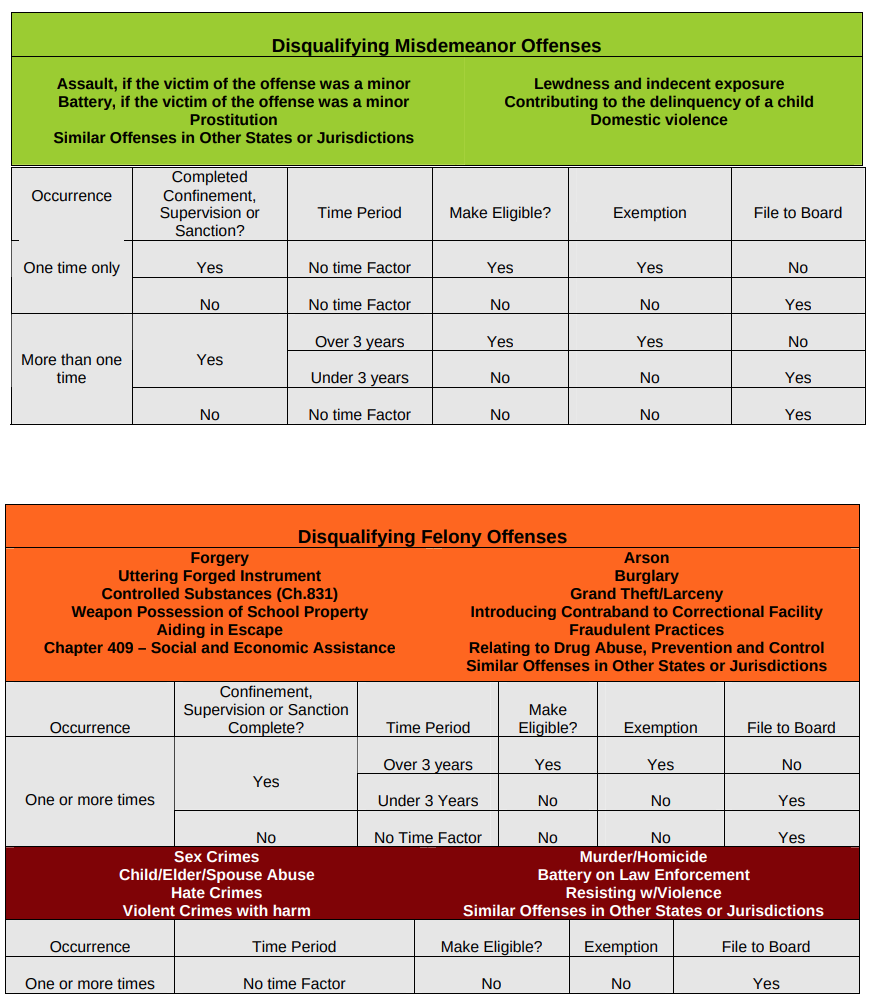
Note on this flowchart: it is the Board of Nursing's published guide from before the 2025 amendment, so the time periods it shows still reflect the old 3 year rule. The waiting period for felony exemptions is now 2 years under the current section 435.07. The decision flow itself (what gets cleared by staff versus what goes to the Board) still works the same way.
If your felony is on the disqualifying list, you are not automatically finished either. That is exactly what the exemption process exists for.
How does the exemption from disqualification work under §435.07?
§435.07, Florida Statutes allows the state to grant an exemption from disqualification to a person who would otherwise fail the Level 2 screening. Here is how it works for CNA applicants:
- Who is eligible: for a disqualifying felony, at least 2 years must have passed since you completed every condition of your sentence, including confinement, probation, and parole. For disqualifying misdemeanors, you are eligible once the sentence is fully completed. Court ordered fees, fines, and restitution must be paid in full first. The 2 year felony period comes from a 2025 amendment to section 435.07, Florida Statutes (chapter 2025-156, Laws of Florida); older state forms and many websites still say 3 years. If a form you are handed still says 3 years, the current statute controls; ask the board rather than assuming you are ineligible.
- Who is never eligible: designated sexual predators, sexual offenders, and career offenders.
- Who decides: for CNAs and other professions certified by the Department of Health, the exemption request goes through the licensing board, meaning the Florida Board of Nursing. The Agency for Health Care Administration handles exemptions only for unlicensed health care workers. The decision is discretionary.
- The standard: you must demonstrate by clear and convincing evidence that you should not be disqualified. The statute names the rehabilitation factors: the circumstances of the offense, time passed, harm caused to any victim, and your history since the incident.
- What you submit: per the state's published requirements, expect a current Level 2 screening, arrest reports and court dispositions for every offense, a probation completion letter if that applies, three to five reference letters including one from your most recent employer, your five year employment history, and documentation of rehabilitation such as completed treatment programs, training certificates, and community involvement.
- Timelines: the state publishes no processing guarantee. Straightforward exemption cases commonly add weeks to a few months on top of normal application processing.
- If you are denied: the decision can be contested through an administrative hearing under chapter 120, Florida Statutes.
One more thing worth understanding: a granted exemption does not erase or change your criminal history. It restores your eligibility despite the record, and it can be voided if you pick up a new disqualifying offense afterward. The exemption instructions and forms are on the Department of Health's background screening exemption page.
Should you apply anyway or ask the Board first?
There is no official pre-clearance mechanism. You cannot get a binding answer about your eligibility before you apply for the state exam and pay the fee; the Board of Nursing reviews your history only as part of a real application. Professionals, including us, can make educated guesses, but only the Board decides. Our practical advice: unless your record contains a clearly disqualifying offense that is not yet exemption eligible, apply, and prepare your paperwork first. Order certified dispositions from the clerk of court in every county where you had a case, and answer the criminal history questions truthfully, since undisclosed history that surfaces on fingerprints looks far worse than disclosed history with documents attached.
Will a criminal record delay my application?
Usually, yes. As of mid 2026, students without any record typically wait about 4 to 6 weeks from application to receiving a test date from Prometric. If your application requires a criminal history review, budget at least an extra month, and closer to 2 to 3 months total for more involved cases, depending on the Board's backlog and how complete your documentation is. Sending complete court dispositions with the application is the single best way to keep the review short.
How are employer background checks different from the state screening?
Passing the state's screening gets you certified, but employers screen separately. Nursing homes, home health agencies, and similar providers must run their own Level 2 checks through the state's Care Provider Background Screening Clearinghouse, applying the same §435.04 standards, so an exemption you obtained matters there too. Employers may also run commercial background checks and apply their own hiring policies, which can be stricter than the state's. The realistic picture: a certificate plus an exemption opens the door, but some individual employers will still say no, while others, especially those facing staffing shortages, routinely hire CNAs with old records.
What we have seen with our students since 2008
We have worked with thousands of students since 2008, and a meaningful share of them started with something on their record. The pattern is consistent: most records, especially scattered misdemeanors and older non violent cases, end in approval, just on a slower clock. The cases that stall are rarely about the offense itself; they stall over missing court dispositions, unpaid fines or restitution that block exemption eligibility, and charges that are still open. The students who sail through gathered their paperwork before applying and disclosed everything up front. Anxiety about a record stops far more people from becoming CNAs than the record itself ever does.
A plain language note: this page is general information, not legal advice, and we are not a law firm. The Department of Health and the Board of Nursing are the only authorities that decide eligibility, and if your situation is complicated, an hour with a Florida licensing attorney is money well spent.
If you already hold a CNA certificate in another state and are moving here, the screening rules on this page apply to you too; our guide to CNA reciprocity in Florida covers how the transfer itself works.
Frequently asked questions about becoming a CNA in Florida with a criminal record
Can you be a CNA with a misdemeanor in Florida?
Usually, yes. Most misdemeanors, including petit theft, a first DUI, and simple possession, are not disqualifying under §435.04. The main exceptions are misdemeanor domestic violence, assault or battery on a minor, prostitution related offenses, and lewdness or indecent exposure.
Can I become a CNA in Florida with a felony?
Often, yes. A felony that is not on the §435.04 list does not fail the screening. A listed felony requires an exemption under §435.07, available 2 years after you complete every condition of your sentence, with all court ordered money paid. Health care fraud felonies carry longer waits under §456.0635. If your longer-term plan is nursing school, note that LPN and RN licensure apply stricter criminal history rules than CNA certification, something to weigh before starting the CNA to LPN to RN ladder.
Does a DUI disqualify you from becoming a CNA in Florida?
A misdemeanor DUI is not a disqualifying offense under §435.04. You must still disclose it, and the Board may request the court disposition, which can add processing time. Felony DUI cases involving serious injury deserve a closer look.
Do arrests without a conviction show up on the Level 2 background check?
Yes, the arrest will appear, but a charge that was dropped, dismissed, or ended in acquittal is not disqualifying. Obtain the court's final disposition ahead of time. A charge still pending for a listed offense holds up your application until it is resolved.
Will a sealed or expunged record affect my CNA application?
Sealed or expunged juvenile delinquency records are excluded from disqualification by §435.04. Adult sealed or expunged records are more complicated, because screening for positions serving children, the elderly, and disabled adults can still allow access. Ask the attorney who handled your sealing before applying.
How long does the exemption from disqualification take in Florida?
The state publishes no guaranteed timeline. Normal applications currently take about 4 to 6 weeks to reach a test date, and a criminal history review or exemption request commonly pushes the total to 2 to 3 months.
How much does the CNA background check cost in Florida?
Plan on roughly $80 for Level 2 fingerprinting at a Livescan vendor, using ORI number EDOH0380Z, plus the $155 state exam fee. If your fingerprints are rejected for image quality, the redo is free using the TCR number from the rejection notice.
If your record is not a hard bar, the fastest route is the same one our students have used since 2008: prepare with our online course, then challenge the Florida CNA exam directly, with up to 3 attempts within a 2 year period. The course is $199, and it walks you through the entire application, including exactly how to handle the background check. Gather your court paperwork, be straightforward on the application, and let the Board do its review; for most people with a past, this career is very much still open.
 Written by Jaime Arias, owner of Florida CNA Online since 2020.